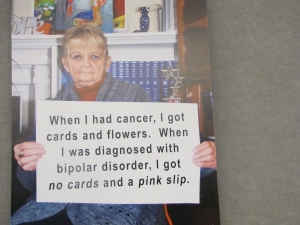
“When I had cancer, I got cards and flowers,” Karen Kangas’ sign reads. “When I was diagnosed with bipolar disorder, I got no cards and a pink slip.”
A picture of Kangas holding the sign hangs in the state Capitol complex, part of an exhibit called “Discrimination: A Roadblock to Recovery.”
The title is no accident.
People often talk about the stigma of mental illness. But some, including Patricia Rehmer, prefer the term “discrimination.” It’s stronger. It makes people uncomfortable.
And it more accurately describes what people with mental illness face when looking for jobs and housing, in social situations, and even in some legislation that’s been proposed in recent years, said Rehmer, the state’s commissioner of mental health and addiction services.
“I always say it’s the last bastion of discrimination,” she said. “I can’t really think of another group that’s still so discriminated against.”
The photo exhibit, which Rehmer’s department co-sponsored, was planned months before the shooting massacre at Newtown’s Sandy Hook Elementary School, which drew lawmakers’ attention to the mental health system. By coincidence, several of the photographs were taken the day the shooting occurred.
But the exhibit’s presence in the walkway between the Legislative Office Building and the Capitol comes at a time of heightened concern for many people involved with mental health issues, who worry the response to the shooting will reinforce negative attitudes and produce legislation based on a skewed view of mental illness.
Those concerns came up during a reception to showcase the exhibit Monday.
“One man committed one horrific act and the whole country talked about reforming the mental health system and comparing us to violent people, and that’s not fair,” Deron Drumm said to applause from an audience composed largely of people in the photographs.
The slogan of disability groups is “nothing about us without us.” But in the media and in policy discussions, Drumm said, “There’s been a lot of ‘without us.’”
Drumm is one of the exhibit subjects. He’s pictured holding a sign that says, “People viewed my gambling addiction as a moral weakness…and not a sickness.”
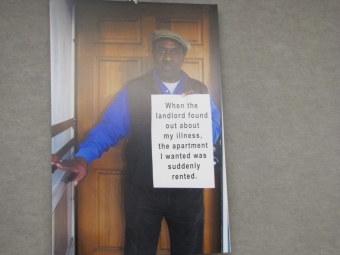
Other photographs, taken by Department of Mental Health and Addiction Services communications specialist Tom Gugliotti, show people holding signs that explain what they faced:
Martin Burke
“My neighbors stopped talking to me when they found out I had schizophrenia.”
“I couldn’t find a study group at school — nobody wanted the ‘crazy’ kid.”
“I stayed in the hospital 4 extra months because it was so difficult to site a group home in any neighborhood!”
“Before being hired, I had to sign a form stating that I had not been hospitalized for one year.”
One man is pictured holding a photograph of his father. In his other hand, he has a sign: “Maybe if it was easier to talk about, my father would have gotten help instead of ending his own life.”
Martin Burke was photographed with a sign that read: “When the landlord found out about my illness, the apartment I wanted was suddenly rented.”
The application Burke filled out asked if he was associated with any clubs, and Burke wrote that he was — with the Chrysalis Center, a social service agency.
“That’s where all the whackos go?” he said the landlord asked him, before asking whether he worked there. No, Burke told him, I’m a member.
“He gave me a funny look, and I never heard from him,” Burke said.
Burke, who has been diagnosed with manic depression and schizophrenia, said he’s also faced discrimination when trying to get a job. He now works supporting other people at Advocacy Unlimited, which helps people in recovery from mental health issues advocate for themselves and for public policy.
What will change the way people with mental illness are treated?
“Exposure,” he said.
As an example, he cited the apartment where he lives now, in Berlin. The property manager has a relative with bipolar disorder, and when she learned about his diagnoses, she expressed concern — about how he was doing, not about keeping him out.
Anti-stigma campaigns have an effect, but Rehmer said research suggests that interaction has a bigger effect in addressing attitudes toward people with mental illness.
“The only way to really reduce it is to have people interacting on a regular basis in normal situations with individuals who do have substance abuse disorders and mental health disorders and see that they’re really no different,” she said. “It’s just a part of who they are.”
Kangas, who lost her job as a principal because of her bipolar diagnosis, now works as executive director of Advocacy Unlimited, which cosponsored the exhibit.
Years ago, Kangas said, she would have been lucky to get a couple people willing to have their photos used in an exhibit about mental illness. Now, everyone she asked said yes.
“That’s what changes discrimination,” she said, “because we look and we stand proudly and then we talk about it.”
Follow Mirror health reporter Arielle Levin Becker on Twitter.