Connecticut wrongly denies food stamps to eligible residents at a higher rate than any other state. It ranks among the worst in the nation in processing food stamp applications on time and paying out accurate levels of benefits. And federal officials warn that without a “tremendous turnaround,” the state could face significant financial sanctions.

Starkowski: We know we have a problem
“We’re really concerned with what’s happening in Connecticut,” James Arena-DeRosa, northeast regional administrator for the U.S. Department of Agriculture’s Food and Nutrition Service, told members of the Human Services and Appropriations committees Tuesday.
Legislators called the figures he presented shocking. Twenty-six percent of cases in which food stamps were denied or cut off were the result of errors, according to preliminary fiscal-year 2010 figures based on a sample of cases. Fewer than 60 percent of applications were processed in a timely manner, and the rate of inaccurate benefit payments was second-worst in the country.
Arena-DeRosa noted that the state Department of Social Services, which administers the program, has faced a “tremendous challenge” addressing the increased demand for food stamps. The number of state residents receiving food assistance grew by 30 percent from the 2009 to 2010 fiscal years, to more than 336,000 people.
But Arena-DeRosa and deputy regional administrator Mary Ferris warned that the state could face financial sanctions if it does not improve its performance. Ferris estimated that the sanctions could range from $800,000 to $1 million.
Appropriations co-chairwoman Sen. Toni N. Harp, D-New Haven, called the numbers embarrassing for both the department and the General Assembly.
“Not because we’re last,” she said. “But more so because of the people who’ve been denied benefits inappropriately and people who’ve had a hard time getting them in the first place.”
DSS Commissioner Michael Starkowski said the problems are the result of understaffing, outdated technology and the surge in demand for services the department administers.
“The underinvestment that we’ve made in the staff and the underinvestment that we’ve made in the technology has come home to roost,” he told legislators.
Food stamps–known formally as the Supplemental Nutrition Assistance Program, or SNAP–are fully funded by the federal government, and the state receives federal reimbursement for 50 percent of the cost of administering the program.
Starkowski described DSS as attempting to address rising demand for services with a dwindling staff, which is down more than 19 percent since 2001. The department was only allowed to hire 58 workers to evaluate applicant eligibility after losing 120 in a 2009 early retirement incentive program, he said.
DSS administers a vast array of health and welfare programs, from child care subsidies to elderly prescription assistance, and staff members evaluate clients’ eligibility for all programs the department administers. The 586 people currently doing intake and case management each handle an average of 1,750 cases a month, Deputy Commissioner Claudette Beaulieu said.
“That is frankly staggering,” she said.
And workers have to process applications using technology Starkowski referred to as “our dinosaur.” The enrollment management system the department uses was designed in 1989 and uses a programming language so outdated it can take 3 to 6 months to make a change in how it works, he said.
“We’re saying we know we have a problem,” he said.
The USDA officials pointed to other factors that set Connecticut apart. Many other states have workers specialize in a particular portion of the eligibility process, such as intake, verifying information or recertification, rather than handling an individual case from start to finish.
Ferris said the DSS workers who once specialized in SNAP now have other responsibilities too. No other state in the region has done that, she said.
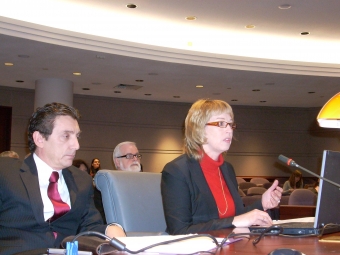
USDA’s James Arena-DeRosa and Mary Ferris: state could face sanctions
Arena-DeRosa said Vermont is hiring more workers to handle applications. And he suggested learning lessons from some DSS offices that are performing better than the state as a whole. “In some places, it’s not as bad,” he said.
He and Ferris also noted that DSS’ information technology system has serious shortcomings.
They said their agency can serve as a partner for the state in addressing the problems, and said the federal government can provide technical assistance.
Other states that have successfully modernized their systems have used online applications, call centers that can free eligibility workers to handle cases, and document imaging centers that allow for paperless functioning, they said.
Starkowski said implementing a new eligibility system could be a multi-year process and cost hundreds of millions of dollars, although much of it could be reimbursed by the federal government. Gov. Dannel P. Malloy’s proposed budget calls for $2 million and 10 staff over the next two years to work with consultants to write a request for proposals for a new system.
As for more immediate fixes, Starkowski said there’s no silver bullet, but the department is trying to chip away at the edges until it can get a new eligibility system and more staff to handle the caseload.
The department received authorization to hire 25 eligibility service workers and expects to get final approval within the week, he said.
In three months, an interactive voice response telephone system should be available that would allow people to call in and receive information about the status of their applications or the level of benefits they’ll get without requiring staff time, Starkowski said. After that, the department is expected to get a document imaging system that will make it easier for workers to access files. The department handles more than 3.7 million pieces of paper each month, he said.
DSS is also looking into arrangements that would allow community agencies to help process food stamp applications. The state must determine eligibility, but outside agencies could help clients prepare applications.
And officials are developing pilot programs for some offices. Some have SNAP-only units, and one office will get a call center for SNAP and HUSKY health plan cases. The department has also increased accountability, including requiring supervisors to review cases.
But Starkowski noted that the department is facing increased demand across the range of social service programs it administers. If he dedicated 30 percent of his staff to processing food stamp applications, he told legislators, he would probably be back in front of legislators in a few months, explaining why applications for HUSKY or other programs are not being processed in time.