NEW HAVEN – Here in the city’s Adult Education Center, alongside former dropouts in their 20s and 30s or older, hundreds of teenagers such as Leandrae Doward also are signing up for a second chance at a diploma.
“I had an attendance problem,” said Doward, a 16-year-old who dropped out of Hillhouse High School as a sophomore. “They were going to hold me back, so I had to leave.”
As New Haven and several other cities enroll a growing number of teenagers in adult classes, some educators and children’s advocates are calling for legislation to reverse what they see as a worrisome trend.
“Basically, the idea . . . is to make adult education only for adults,” said Josh Michtom, a lawyer for the Center for Children’s Advocacy at the University of Connecticut School of Law. The center is backing a proposal making it harder for schools to send low-performing, overage or difficult-to-handle students to adult programs.
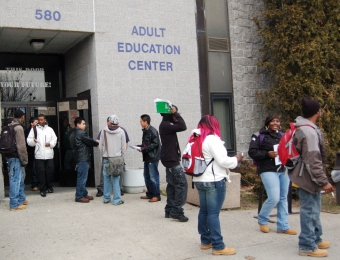
Students gather outside the New Haven Adult Education Center, where an increasing numbers of teens are enrolling.
“The existence of adult education encourages some administrators to ‘counsel’ kids there,” he said.
Across the state, several cities report sending substantial numbers of high school age students to adult programs. In New Haven, for example, more than 500 students aged 16 to 18 enrolled in adult classes last year. If those students are counted along with overall numbers of sophomores, juniors and seniors in New Haven’s public high schools, adult education enrolls nearly 13 percent of city students in that age range.
Similarly, according to figures reported to the State Department of Education, about 6 percent of students of that age group in Bridgeport are in adult classes. In Hartford and New Britain, the figure is 9 percent, and in Waterbury 14 percent.
Michtom described adult programs as a scaled-down version of high school with fewer hours of instruction and fewer programs such as physical education, foreign language classes or counseling services.
Students who transfer to adult programs often are in need of extra help, he said. “Putting them in a pared-down program, it’s more difficult for them to succeed.”
Many who enroll in adult education do not get diplomas. Some leave the program for jobs or family obligations while others simply drop out. Of the 526 New Haven students aged 16 to 18 who attended adult education programs last year, 118 received high school diplomas, state figures show.
“We lose a lot of students who migrate out into the streets,” said Nicholas Montano, assistant principal at the New Haven Adult Education Center, a large nondescript building where students take basic courses such as algebra, English and science leading to a high school or GED diploma.
Montano said it is difficult to accommodate the high numbers of teenagers who are signing up for classes.
“The 16-to-17-year-old young adults belong with their peers in traditional high schools,” he said. “There is so much more traditional high schools can offer young people. . . . We’re really trying to address the needs of adults.”
The teens wind up in adult programs for a wide range of reasons. Many are having academic difficulty or are in trouble in school. Some have family obligations and are the main caregivers for younger brothers and sisters, Montano said.
“Some kids just can’t do a six-hour day” in traditional high schools, he said. “We offer a three-hour day, four-hour day. It’s good for them. They can hold down a job in the afternoon.”
The shorter school day appealed to 18-year-old Tyquana Mathis, who left Wilbur Cross High School in her junior year. “I just couldn’t concentrate in class. I felt I needed to get out of school early,” she said. In the adult program, “It’s easier for me — the hours. We don’t have school Fridays. I love it.”
Reginald Mayo, New Haven’s superintendent of schools, said the school system is working to reduce the number of dropouts and that adult education, for some, is a good alternative.
“A kid that goes to adult education – in my opinion, it’s not the worst thing in the world,” he said. “It’s an option for that kid. There’s a basic education program where kids take core subjects.
“Some kids have to stop to work. Some kids have not done well at the regular high schools. Some kids just can’t take school all day.”
Do schools sometimes counsel a student out of regular programs and into adult classes?
“I’m sure that happens,” Mayo said. “It beats him dropping out of school. . . . Why not recommend something? There is not one shoe that fits all.”
Seventeen-year-old Ronneisha Robinson enrolled in adult classes after leaving Hillhouse High School, where she had fallen behind and had to repeat a grade. “It was kind of embarrassing to be held back,” she said. “The friends I was hanging with were not going to class.”
She said a counselor and assistant principal thought adult classes would be a good idea, but “my mother didn’t want me to do it at first.” Now, however, “she’s glad I’m going to graduate.” In the adult program, “the hours are better, and the people are more mature than they are in high school,” said Robinson, who hopes to attend college someday and become a registered nurse.
In Hartford, Superintendent of Schools Steven Adamowski has taken steps to reduce the number of high school students leaving for adult classes, including a phase-out of a high school credit diploma program that he said had much lower standards than traditional high schools. The district also tightened the rules for teens who want to transfer to adult classes and created the Opportunity High School, an accelerated academic program for overage potential dropouts.
The Center for Children’s Advocacy is backing a bill that would restrict enrollment of students under the age of 18 in adult programs by requiring school superintendents to review written enrollment applications from their parents.
Michtom, who represented the center at a press conference in Hartford Monday, said the bill would, in most cases, close adult education to high school students.
State Education Commissioner Mark McQuillan said he, too, believes “too many kids are eased out the door on the pretext of getting a GED,” but he opposed the bill on technical grounds.
“Adult education serves a very important segment of our population but it has long been underfunded and it cannot afford to divert resources on students who should be enrolled in a comprehensive high school,” McQuillan said in testimony recently before the legislature’s Education Committee. Nevertheless, he said the proposed bill appears to conflict with existing laws and creates confusion over who is eligible to apply for adult education, he said.
Michtom said Monday he has written proposals to amend the bill to take into account some of the objections raised by McQuillan and others.
Also attending Monday’s press conference was state Rep. Jason Bartlett, D-Bethel, who called for a reform of adult education programs.
“We should not be having dropout factories across the state of Connecticut. . . . It’s disgraceful to know we have school systems with over 500 kids going into adult education,” he said.
Bartlett said he supports legislation that would require school districts to report official enrollment counts near the end of the school year, creating a financial incentive to keep students in school longer. Currently, official enrollments, which are used to calculate state aid, are reported in October.